
ROTATE
Rotate selected objects around a base point.
- Type
- ROTATE or RO
- On the ribbon
- Home › Modify › Rotate
- Since
- Musa CAD 0.1.0
What it asks first
Command: ROTATESelect objects:Read from Musa CAD 0.8.0 itself (musacad --dump-wiki-data), so these facts always match the release this wiki is built for (0.8.0).
ROTATE turns objects around a point you choose. Type the angle, or turn them with the cursor and click.
How it works
Section titled “How it works”Type RO and press Enter. Select the objects and press Enter. Click the base point, the point the objects turn around. Then type an angle in degrees and press Enter.
Command: ROSelect objects: (pick the L shape)1 found.Select objects: EnterCurrent positive angle in UCS: ANGDIR=counterclockwise ANGBASE=0Specify base point: (click the lower-left corner)Specify rotation angle or [Copy/Reference] <0>: 30Rotated.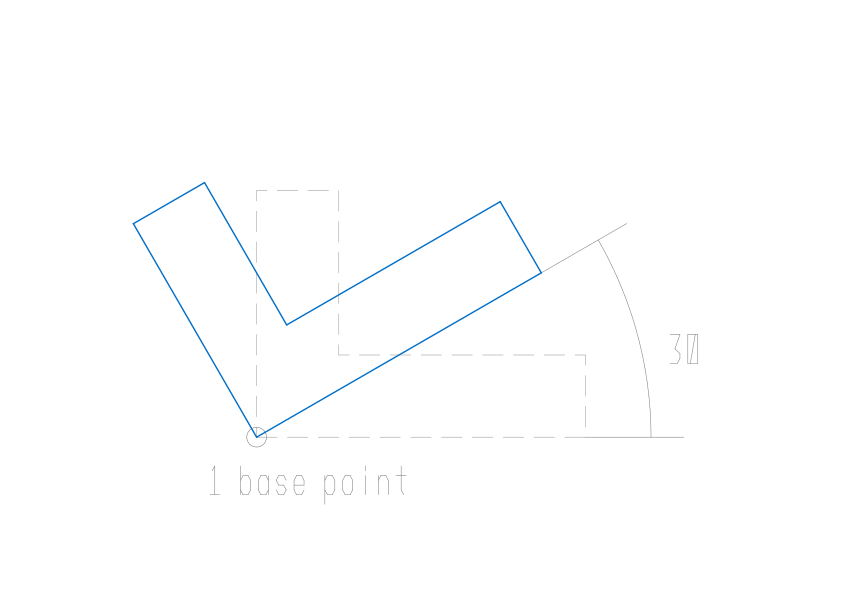
A positive angle turns the objects counter-clockwise, and a negative angle turns them clockwise. Before you type, the objects turn with the cursor and the angle shows beside it. Click instead of typing, and the angle is the direction from the base point to where you clicked.
Options
Section titled “Options”| Option | What it does |
|---|---|
Copy (C) | Turns a copy and leaves the originals where they are. Musa CAD says Rotating a copy of the selected objects. and asks for the angle again. |
Reference (R) | Turns the objects from a direction they have now to a new one. See below. |
| Enter at Specify rotation angle | Uses the default, 0, so nothing turns. |
Turning to match a direction with Reference
Section titled “Turning to match a direction with Reference”Reference is useful when you do not know the angle to turn by, only where the objects should point. Musa CAD turns them by the new angle minus the reference angle.
Specify rotation angle or [Copy/Reference] <0>: RSpecify the reference angle <0>: (click one end of an edge)Specify second point: (click its other end)Specify the new angle or [Points] <0>: 90Rotated.- At Specify the reference angle, type the angle the objects point at now, or click two points along an edge.
- At Specify the new angle, type the angle they should point at, or click a point: the direction from the base point to it is the new angle.
- Points (
P) lets you give the new angle with two points of your own, for example along another object.
In the example, the edge you clicked ends up pointing straight up, at 90 degrees.
Selecting objects
Section titled “Selecting objects”At Select objects: you build up the set of objects to turn. Each pick or window adds to it, and Musa CAD says how many it found, such as 1 found. or 2 found, 5 total.
- Click an object to add it.
- Click an empty spot, then click again to draw a box. Going from left to right makes a window: it takes only objects that lie completely inside. Going from right to left makes a crossing window: it also takes objects that only touch it.
- Press and drag to draw a free shape, called a lasso. Start dragging to the right for a window, to the left for a crossing.
- Hold Shift and click a selected object to take it out again.
- Press Enter, or right-click, when the set is complete. If nothing is selected, ROTATE ends.
If objects are already selected when you start ROTATE, it uses them and goes straight to the base point. You can also type a keyword at Select objects:, such as ALL for everything or P for the objects the last edit worked on. SELECT lists them all.
Good to know
Section titled “Good to know”- A number you type is always taken as degrees. Anything that is neither a number nor a point is refused with
Requires valid numeric angle or second point. - The angle is not remembered. The default is always 0.
- When it is done, Musa CAD says
Rotated., orRotated a copy.with Copy. The turned objects stay selected. - Associative dimensions and hatches that are attached to the turned objects go with them, even if you did not select them.
- One ROTATE is one undo step. Esc cancels, and nothing turns.
- Objects on layers that are off, frozen or locked cannot be selected.
Compared with AutoCAD
Section titled “Compared with AutoCAD”ROTATE follows AutoCAD’s prompts: the base point, then the angle with Copy and Reference, and Points for a new angle from two points.
- Move, turn and scale objects onto other objects in one step with ALIGN.
- Make objects larger or smaller with SCALE.
- Read more about changing drawings in Modifying objects.